by Satid Sutipanya, TAF Thailand Correspondent
This coming October 2026, the high-profile meeting between the International Monetary Fund (IMF) and the World Bank Group (WBG) will take place once again in Bangkok, Thailand under “The IMF-WBG Annual Meeting 2026” after hosting the annual meeting for the first time in 1991.
The meeting will bring policymakers, business leaders, and decision-makers across 191 member nations of the Bretton Woods Institutions, the collective name for the IMF and the World Bank Group, to Thailand, which could help boost Thailand’s sluggish tourism sector hit severely hard by both COVID-19 and the current world’s energy shocks.
Against the backdrop of the annual meeting, one key issue to consider is the comparative economic growth of the Thai economy between the 1990s and now.
The Kingdom’s economy had expanded by 8–11% during the late 1980s to the early 1990s due to significantly high foreign investment flows enhanced by relatively low wages, reduced trade barriers, and stable macroeconomic policies, which kept inflation low and the exchange rate stable, according to a paper conducted by the Thailand Development Institute (TDRI).
One key driver of this growth was the influx of Japanese investment. In 1985, the Japanese government, among other five members, including France, Germany, the United Kingdom, and the United States, had signed an agreement to allow coordinated intervention in currency markets to strengthen the U.S. dollar, later called the Plaza Accord Agreement.
One implication of the agreement was the Yen’s appreciation, making manufacturing and exporting in Japan during the late 1980s to the 1990s difficult. Therefore, the tough investment atmosphere during the time led to the flow of Japanese investment into Thailand, especially in the automobile industry, in the 1990s, which was the key foundation of Thailand’s economic boom at the time.
The Thai government also initiated the Eastern Seaboard (ESB) project to attract more foreign direct investment (FDI) with numerous tax incentives. The ESB provided tax perks to multinational firms, mainly in the automobile industry, to build their factories in the eastern area of Thailand. The initiative has driven the Thai economy by creating millions of jobs, making Thailand the ‘Detroit of Asia’.
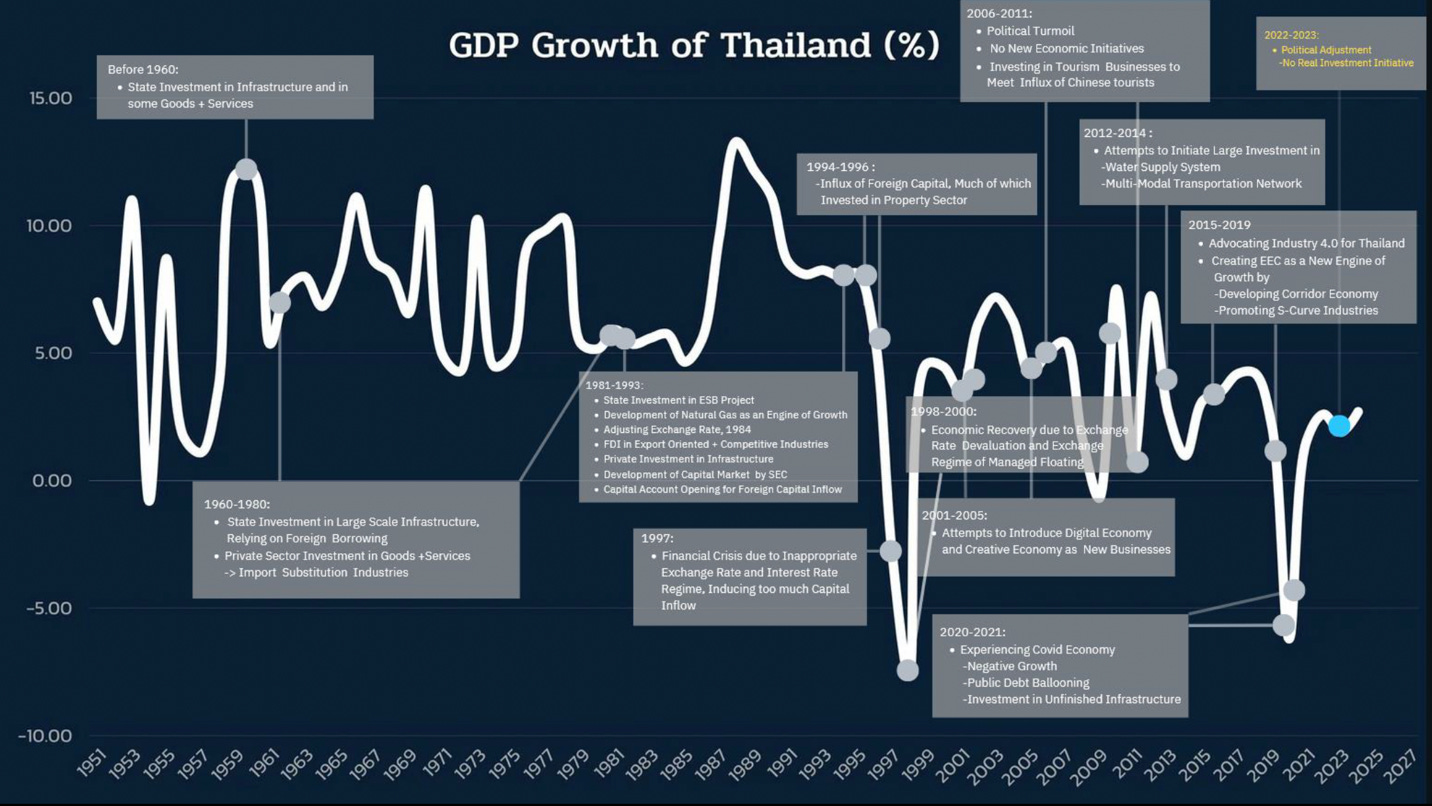
However, a series of crises — the Asian Financial Crisis in 1997, the Global Financial Crisis in 2008, the outbreak of COVID-19 in 2020, the reciprocal tariffs implemented by Donald Trump, and the ongoing oil-price shocks — have gradually reduced the country’s economic growth from well above 10% to merely 1–2% today.
Thailand today is facing significant challenges from both internal problems and external shocks. For the former, rising household debt, limited fiscal space, ballooning fiscal deficits, mounting public debt, and over-reliance on export and tourism are the key challenges; for the latter, disruptions in the global trade system and the spike of the world’s oil prices are the primary concerns.
Besides economic challenges, political instability is another significant factor hindering the Thai economy for many decades, which has prevented governments — particularly anti-establishment ones — from implementing long-term structural reforms. Since becoming a constitutional monarchy in 1932, there have been 13 successful coups in the Kingdom; every successful coup also leads to a new amendment of the constitution. Thailand has gone through approximately 20 versions of its constitution since 1932.
Ekniti Nitithanprapas, Thailand’s Finance Minister, said during a press conference on the formal launch of the IMF-WBG Annual Meeting in March 2026 that the Thai economy now and in the 1990s had different problems. In the 1990s, it was a matter of overheating, meaning the economy expanded at an unsustainably fast pace without proper regulations from the government, while the Thai economy now is experiencing new shocks, for example an aging population.
Ekniti added that in order to upgrade Thailand’s potential growth, the government needs to focus on infrastructure investment as well as digital transformation and Artificial Intelligence (AI) adoption to attract more foreign investment, upskill the workforce, and increase productivity.
“By adopting those innovations, Thailand will be able to attract investment from everywhere, not only to Thailand but to the region, and use that as a way to upgrade our potential growth that can be shared and learned from each other,” said Ekniti.
Kristalina Georgieva, Managing Director (MD) of the IMF, said during the same press conference that global growth is slowing compared to its historical trend. The pre-COVID trend growth rate averaged about 3.7–3.8%. Now, the rate is around 3.2–3.3%.
“The factors slowing the growth down are that productivity has not been growing fast enough,” said Georgieva, adding that “So if we want to see faster growth, we have to focus on what are the obstacles to productivity growth.”
To increase output in the economy, she suggested that each government needs to follow three priorities: deepen capital markets instead of heavy reliance on bank loans, leverage AI to increase productivity growth, and improve the allocation of labor and capital.
“We assess that, in Asia, there could be all the way up to 1% increase in productivity if AI is taken as an advantage for the economy,” said Kristalina, adding that “Also make sure that the factors — labor and capital — are all deployed to the fullest, while reducing red tape.”
Satid is a multimedia economic journalist and news anchor who covers macroeconomic trends, Thailand’s fiscal policy, and key regional developments for Bangkok Biz. A Journalism graduate from Thammasat University, he has reported on major issues such as the US–China trade tensions, the Myanmar crisis, and global corporate stories, drawing on prior newsroom experience at The Momentum, the Bangkok Post, AFP, and Varasarn Press. His work blends economic analysis, foreign affairs, and digital storytelling, with a strong focus on making complex financial and political topics accessible to Thai audiences.
Edited by Alan J. M. Bron, Frontier Analysis Editor