


Editor’s Note
by Mattia Peroni, Lead Editor - Mekong Belt Desk
This issue of the Mekong Belt analyzes how governments across the region are managing the stories they tell, uncovering where the plot diverges from reality. In Myanmar, Min Aung Hlaing has rebranded a coup as a "National Resurgence," complete with a 100-Day Plan that reads more like a press release than a policy: big words, big promises, but no recovery plan for the economy. In Cambodia, Hun Sen signed a royal pardon with one hand and kept every political shackle in place with the other: Kem Sokha walks free, but he can't run, vote, or even leave the country, which raises the question of what exactly was pardoned.
Meanwhile, in Laos, the government actually decided not to tell a story, saying nothing for three days while seven men suffocated underground. It was their families, posting frantically on Facebook, who broke the story the state refused to tell. And in Thailand, record FDI numbers make for dazzling headlines, but when the raw materials are all imported and the knowledge stays with the multinationals, a boom that doesn't root locally is just a story about someone else's growth.
Myanmar 🇲🇲
Myanmar Regime’s 100-Day Plan
by Ley Hlaing
The newly transformed regime under self-proclaimed president Min Aung Hlaing has launched a 100-Day Plan following the formation of its cabinet. The plan prioritizes the rebranding of the regime and the normalization of military rule, but its stated goals sharply contradict the realities on the ground.
Shortly after forming a cabinet of 31 key ministries, Min Aung Hlaing announced the blueprint at the first cabinet meeting on April 20, 2026, setting a deadline of July 21, 2026. State-owned media and regime mouthpieces have since largely portrayed the plan as a National Resurgence. Comprising two main parts — ministry-specific projects and a peace process — the plan reflects severely limited administrative capacity and relies on a broad, generalized scope. The ministry-specific component covers only five of the 31 ministries: Finance and Revenue; Education; Health; Cooperatives and Transport; and Digital Development and Communications. Critics have pointed out that the plan lacks any meaningful measures for economic recovery and is limited in its implementation coverage.
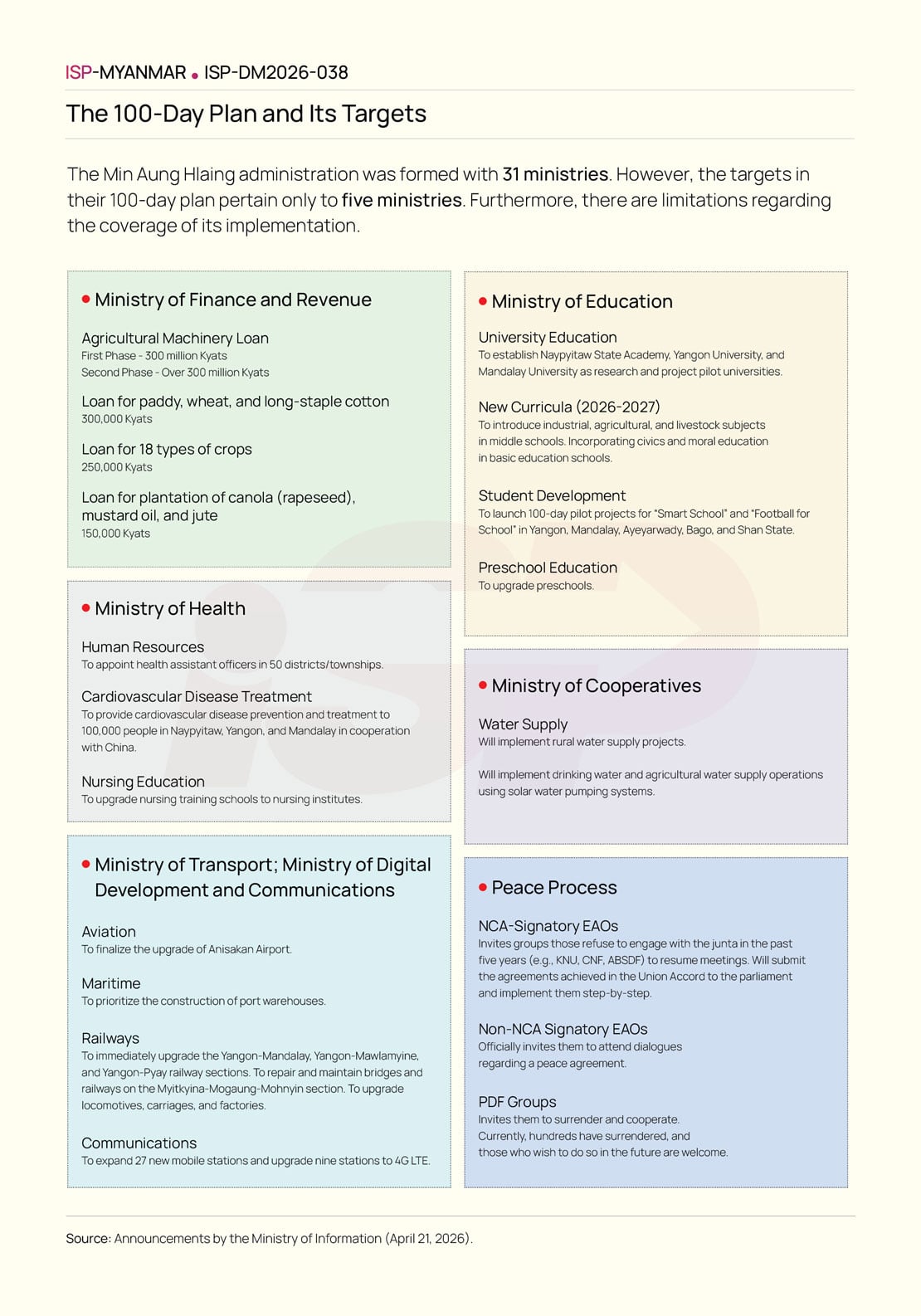
The second component — the peace process — is heavily emphasized, calling on ethnic armed organizations (EAOs) to join peace talks within 100 days and urging heartland People’s Defense Forces (PDFs) to surrender. This mirrors a long-standing tactic of successive military governments: using negotiations to fracture anti-junta resistance. While the invitation is extended to both signatory and non-signatory members of the National Ceasefire Agreement (NCA), it makes no mention of the parallel government, the National Unity Government (NUG). Former NCA signatories have been actively resisting the junta since the coup, and most resistance leaders and spokespeople have expressed no interest in or trust toward the invitation, stating that the regime is reviving the NCA simply because “they need it.” That perceived need points to possible hidden agendas behind this outsized peace overture toward groups the regime once labeled terrorists — among them: normalizing the regime within the 2008 Constitutional framework, resuming Chinese-backed projects under pressure from Beijing, and seeking reintegration into the international community.
While the plan’s goals are prominently declared, the realities are strikingly different. Driven in part by the global energy crisis, reports indicate that average prices of basic food items in Myanmar have risen by 19 percent since late February 2026, deepening hunger among a population already struggling to meet basic needs. The security situation is equally alarming: forced conscription has effectively transformed into human trafficking. Young men, including underage boys, are no longer safe after dark, with forcible recruitment now occurring in major cities such as Yangon and Mandalay — a grim escalation that directly contradicts the regime’s calls for peace. Meanwhile, additional ministries have since joined the 100-Day Plan: Electricity and Energy has pledged to ensure national energy sufficiency and support long-term economic development, while Immigration and Population has moved to implement the La Min project, which involves issuing Citizenship Scrutiny Cards and Unique IDs.
Min Aung Hlaing’s 100-Day Plan is ultimately a survival strategy for a closed regime, not a viable blueprint for recovery. Its “National Resurgence” branding obscures a collapsing economy, a sham peace process designed to splinter resistance, and an intensifying forced conscription campaign fueling a regional human trafficking crisis and accelerating the erosion of Myanmar’s middle class. The international community should recognize these peace overtures for what they are — and respond by rejecting them outright and cutting the economic and political lifelines sustaining the junta’s continued warfare.
Ley Hlaing is a former Political Science student from the University of Yangon, Myanmar. Currently, he is pursuing his BA at Parami University with a major in Philosophy, Politics and Economics. His academic and professional interests span community development, literature, minority issues, and social impact research. Having held roles as Research Assistant, Student Mentor, and Facilitator for local initiatives, he has constantly supported project management in literature and education programs in Myanmar.
Cambodia 🇰🇭
Kem Sokha Pardoned in Cambodia, but Political Ban Remains
by Sokna Thea, in Phnom Penh
Cambodia’s acting head of state Hun Sen signed a royal decree on 25 May 2026 that pardons opposition figure Kem Sokha from a 27-year prison term for treason. The pardon frees him from his sentence only. A lifetime ban on politics and a five-year ban on leaving the country both stay in place, so he walks free but cannot run for office, vote, or travel abroad.
Hun Sen, now Senate president, signed the decree for King Norodom Sihamoni, who is in Beijing for prostate cancer treatment. Under the constitution, the Senate president acts as head of state when the king is abroad. Prime Minister Hun Manet, Hun Sen’s son, requested the pardon and called it a step toward national unity.
Police arrested Sokha in September 2017 and charged him with conspiring with a foreign power, mainly over a 2013 video of a speech about democracy work. A court convicted him in March 2023 after a trial that UN experts said was politically motivated. He spent more than eight years in jail and house arrest. The Phnom Penh Court of Appeal upheld the verdict on 30 April 2026 and added the travel ban, just 25 days before the pardon.
The case removed the main electoral challenger to the ruling party. Weeks after the arrest, the Supreme Court dissolved Sokha’s Cambodia National Rescue Party in November 2017. With no rival, Hun Sen’s party won every seat in the 2018 election and has held full control since.
Analysts read the timing as image management. The exiled Khmer Movement for Democracy, led by Mu Sochua, called it a political chess move that only shifts Sokha from house arrest to political confinement. Pressure on Cambodia has grown. The US sanctioned ruling-party senator and Hun Sen ally Kok An in April 2026 over scam compounds, while the European Union still withholds full trade access over rights concerns. Washington, meanwhile, cut a threatened 49 percent tariff on Cambodian goods to 19 percent in a 2025 trade deal. Phnom Penh also hosts the Francophonie Summit in November 2026.
The move signals Hun Sen retains decisive influence after handing the premiership to his son in 2023. It also fits a wider pattern in Southeast Asia, where Thailand’s Constitutional Court dissolved the election-winning Move Forward Party in 2024. Rights groups warn that dozens of other government critics remain jailed. Human Rights Watch welcomed the release but said it was deplorable that Sokha remains barred from politics and from leaving the country. Sokha, now 72, said he will not seek revenge and plans to enter the monkhood to honor his gravely ill mother.
Sokna has a background in International Affairs and Business & Commercial Law. He’s currently a Senior Project Coordinator at the Ministry of Economy and Finance of Cambodia, working on the Financial Management Information System (FMIS) Project. His professional focus is driven by entrepreneurship, business development, and financial technology, with a particular interest in how private-sector innovation drives Cambodia’s economic growth.

Lao PDR 🇱🇦
Seven Men Trapped in Flooded Laos Cave
by Thongsavanh Souvannasane, in Vientiane
Eight days on, and seven men are still trapped underground in northern Laos, and no one has heard from them since the cave sealed shut.
The men, aged in their twenties and thirties, entered a cave in Longcheng district, Xaysomboun Province, on 20 May. Heavy rain triggered flash flooding and a landslide that blocked the entrance, trapping them inside a subterranean gold mine. Authorities were alerted by a member of the group who managed to escape before the exit was blocked.
The story did not break immediately.
For nearly three days, no official announcement came. It was the trapped men’s siblings and family members who raised the alarm, posting desperate appeals on Facebook, tagging rescue organizations, and sharing information in Lao-language community groups. That grassroots surge pulled the story into public view across Laos and the region.
Why the men entered the cave remains disputed.
Initial reports say around eight villagers were hired by a Chinese mining company to search for gold, earning about LAK 100,000 (USD 4.58) a day, and one escaped before the tunnel flooded. Other accounts suggest they went in independently. There has been no official confirmation, though rescuers say the cave was frequented by locals looking for gold despite repeated safety warnings.
On May 23, Lao authorities formally wrote to Thai rescue teams requesting their assistance, citing Thailand’s specialist diving expertise and the rescuers’ depth of experience in flooded cave operations. The request brought a 26-member Thailand-based team to Xaysomboun within days.
About 100 people from Laos and Thailand are now at the site.
To reach the trapped men, rescuers must navigate a 340-meter flooded tunnel, with some passages just 60 centimeters wide. Teams pump water around the clock and thread fresh air through a pipe deep into the system. On 26 May, they broke through 15 meters of sand and gravel in a single day, closing in on the chamber where the men are believed to be sheltering on an elevated ledge with natural airflow.
Then, on the night of 26 May, operations halted. Two rescuers suffered dizziness inside the cave, forcing teams to suspend overnight diving and clear all personnel from the tunnels. The setback, however, came with one piece of encouraging news: water levels inside the cave had dropped nearly two meters, a sign that the round-the-clock pumping is working, and that conditions may be more favorable when teams resume at dawn.
On 25 May, Thailand-based diver Norrased Palasing and Finnish specialist Mikko Paasi, both Tham Luang veterans whose experience navigating submerged, narrow cave systems puts them at the front of this rescue, arrived to join contingent leader Kengkard Bongkawong, who coordinated the 2018 Tham Luang rescue in Chiang Rai Province. Thai instructor Parasu Komaradat provides remote guidance as authorities continue pumping water and preparing diving operations to ensure the safety of all involved.
There has been no contact with the trapped men since they went in. As of 27 May, the rescue operation remains ongoing.
Thongsavanh is a journalist from Laos with a background in English-language media. He graduated from the Lao-American Institute with a Diploma of the Arts in English and contributes to independent news platforms. His reporting focuses on environmental issues, socio-economic development, and geopolitics.
Thailand 🇹🇭
Thailand’s FDI Boom Masks Weak Local Benefits
by Satid Sootipunya, in Bangkok
Thailand’s Board of Investment (BOI) attracted record Foreign Direct Investments (FDIs) of over USD 27 billion (1 trillion baht) to the Kingdom in the first quarter this year, driven by electronic-related industries amid the Artificial Intelligence (AI) boom.
Secretary General of BOI Narit Therdsteerasukdi said in a statement that Thailand’s investment environment has been buoyed by the diverted flow of foreign investment caused by geopolitical shifts and the relocation of manufacturing bases.
In the three months ended March 2026, investment promotion applications were submitted for 24 projects worth 1.016 trillion baht, 2.4 times higher than the same period last year.
Accelerated by geopolitical tensions and the China-plus-one policy, several multinational data center and cloud service companies are eyeing Thailand as their new regional hub, including TikTok Systems, Skyline Data Center and Cloud Services, Global Switch, and Evolution Data Centres.
Former Thailand’s Finance Minister Dr. Somkid Jatusripitak supported this development, saying that the Thai government should attract quality FDIs instead of focusing only on volume. The administration should utilize incoming foreign investment to support Thailand’s future development.
“We must act as architects — designing what kind of future we want for the country,” said Dr. Somkid. This includes addressing rural poverty and improving the livelihoods of farmers.
Despite the surge in FDI applications, the Bank of Thailand (BOT) reported that the use of locally sourced raw materials has declined, with the majority of production inputs being imported.
The report also mentioned that Thailand’s FDI value has increased 1.8 times over the past five years compared with the pre-COVID-19 period, fueled by data centers and cloud services. However, Thailand’s new industrial structure remains concentrated mainly in the midstream and downstream segments.
The big question is whether Thailand will experience another major takeoff from the current flow of FDIs given the changing global investment landscape.
The answer may be no if the government focuses only on the quantity of FDIs instead of quality: requiring multinational companies to transfer knowledge to Thai workers and increasing the use of local content.
Satid is a multimedia economic journalist and news anchor who covers macroeconomic trends, Thailand’s fiscal policy, and key regional developments for Bangkok Biz. A Journalism graduate from Thammasat University, he has reported on major issues such as the US–China trade tensions, the Myanmar crisis, and global corporate stories, drawing on prior newsroom experience at The Momentum, the Bangkok Post, AFP, and Varasarn Press. His work blends economic analysis, foreign affairs, and digital storytelling, with a strong focus on making complex financial and political topics accessible to Thai audiences.
Editorial Deadline 30/05/2026 11:59 PM (UTC +8)
