


by Natamon Aumphin, Paranut Juntree, and Satid Sootipunya- TAF’s Thailand Bureau
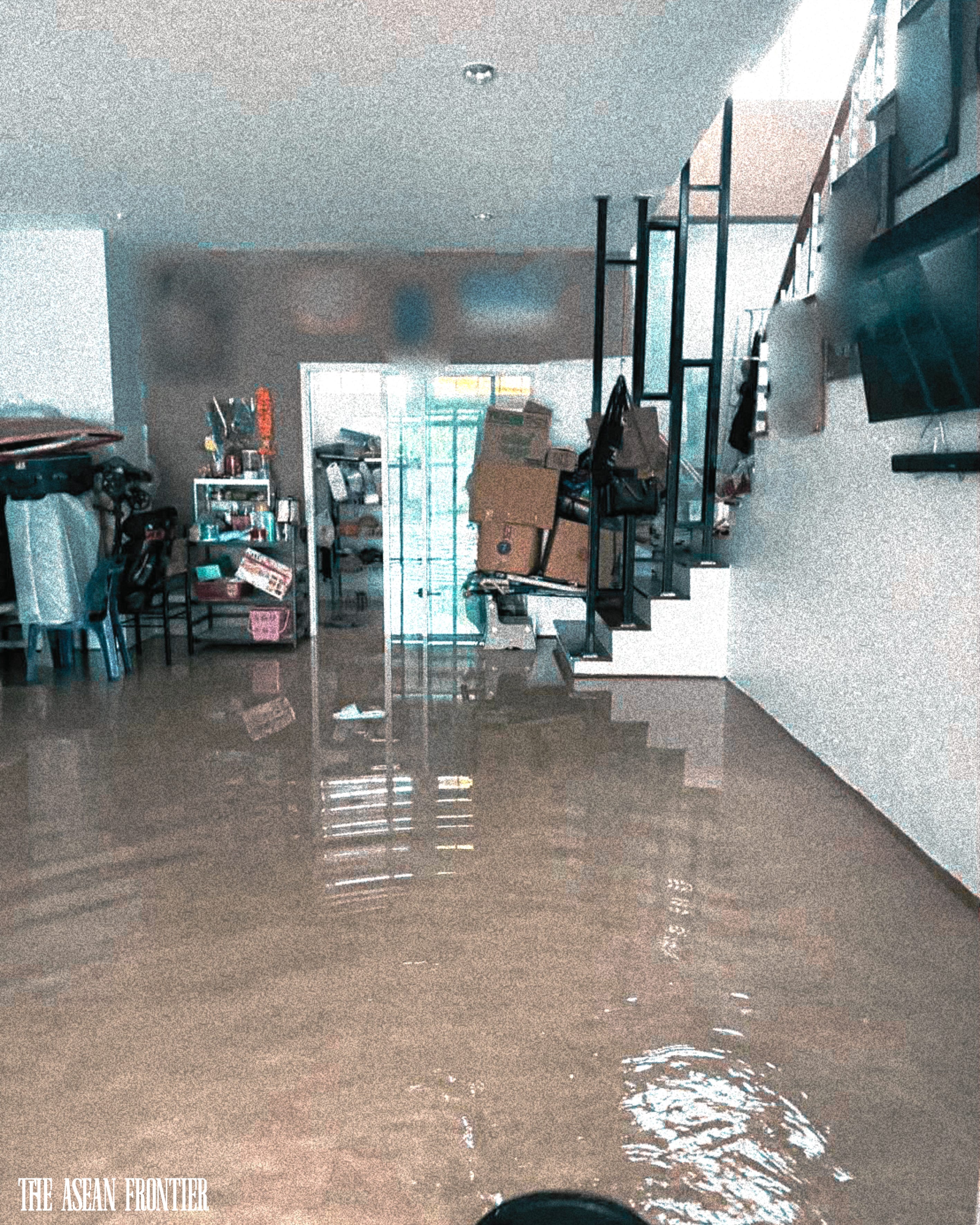
After days of constant rainfall, a mother, who requested to remain anonymous, and her 4-year-old daughter went to sleep on the night of November 21st, only to wake up hours later to the sound of water rushing into the ground floor of their family home in Hat Yai. The rain showed no signs of stopping. What started as a few centimeters of water quickly rose to waist-level within just a couple of hours. By midday, they watched in horror as the ground floor completely disappeared under the deep-brown current. They were forced up to the 2nd floor, and later to the roof, spending three days without food before being evacuated. Others were not so lucky. An 80-year-old woman, who simply “couldn’t hold on any longer,” drowned in her home after water surged to near ceiling-height. Her daughter, trapped beside her, saw her body slowly drifting away and had no other choice but to store it inside their refrigerator, to which she also clung for nearly three days until rescuers reached her.
The severe floods impacted nine provinces in southern Thailand and left at least 176 people dead, according to the most recent reports. The city of Hat Yai in Songkhla province, bordering Malaysia, has been affected the most by the deluge due to its pan-shaped layout, surrounding mountain ranges, and exceptionally heavy rainfall. On November 25, the Thai cabinet declared Songkhla a disaster zone, centralizing all mandates under the government to coordinate disaster response and relief.
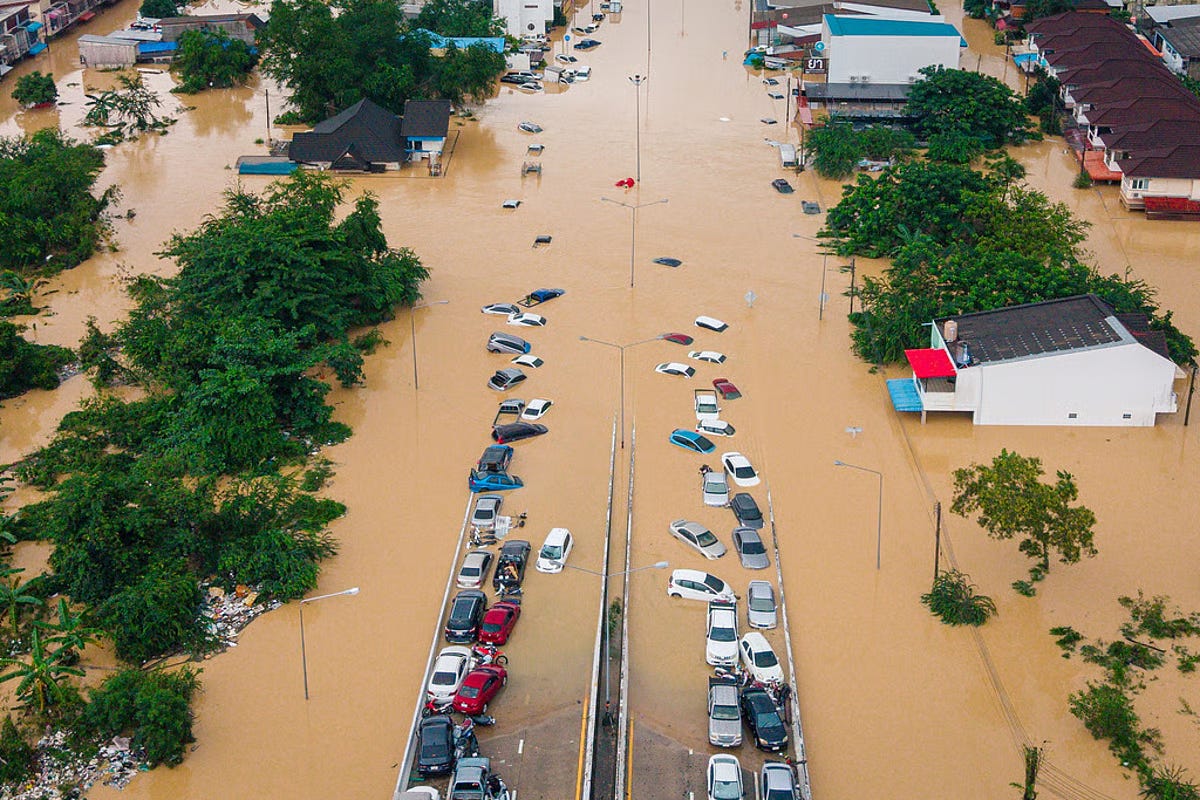
In the South, heavy rainfall began on November 19. In Hat Yai, where flooding conditions peaked on November 21, some residents were stranded for as long as six days, desperately waiting in their homes and on rooftops for relief. In numerous cases, volunteers were able to reach them before official assistance arrived.
The economic fallout from the deluge has not yet been fully estimated by the government. However, the University of the Thai Chamber of Commerce (UTCC) initially forecasted that losses could reach THB 1,000–1,500 million per day, as Hat Yai is the business hub of the South.
Meanwhile, K-Research, the research arm of Kasikornbank, predicts that the disaster could result in economic losses of THB 25,000 million, equivalent to around 0.13% of Thailand’s Gross Domestic Product (GDP), if the deluge continues for a month. Rubber and palm oil—Thailand’s key economic crops, largely produced in the South—are expected to be hit hardest by the floods.
Thailand’s Ministry of Finance announced on Wednesday the launch of relief packages in three phases. The first phase brings together Specialized Financial Institutions (SFIs) to run a donation hub providing urgent assistance to affected households. The second shifts from emergency relief to recovery measures, including soft loans for households and businesses. The final phase introduces longer-term schemes once the economic losses are fully assessed.
Thailand’s flood-management system involves multiple agencies, including the Department of Disaster Prevention and Mitigation (DDPM), provincial administrations, municipal authorities, and the Royal Irrigation Department. When flooding escalated, Prime Minister and Minister of Interior, Anutin Charnvirakul, as Chairman of the Steering and Executive Committee for Natural Disaster Situations, signed an order to establish the Water Management Center for Natural Disaster Situations, appointing Thammanat Prompao as the director.
On paper, the disaster-response protocol appears comprehensive. But on the ground, implementation has been patchy since the early warning was issued on November 20. Residents in Hat Yai reported inconsistent evacuation guidance between the DDPM’s cell broadcast and local authorities. Despite early warnings, they also claim there was an insufficient window for effective evacuation, with confusion compounded by initially reassuring statements from some local administrations regarding the flood’s potential severity. The situation was exacerbated by the lack of clear evacuation instructions, as the early warning broadcast offered almost no practical guidance for residents.
As the flood intensified, many were seeking help from the authorities. However, shortages of boats and temporary shelters, combined with the absence of a clear operational framework, left residents with limited access to help and supplies, as water in some areas rose to the second floor. Social media was filled with real-time updates showing arterial roads underwater long before official channels acknowledged the scale of the crisis. From a Thai PBS Interview, Associate Professor Seree Supratid, Vice President of the National Disaster Warning Council Foundation, reported that senior administrators delayed declaring the ‘red zone’ (highest warning level) despite Hat Yai’s mayor’s request, suggesting that the delay may be linked to other reasons. This points to a mismatch between the lived experience of the affected and official narratives.
The flood crisis has been a dire test of the Anutin administration’s quality, where “crisis is the measure of a politician’s quality.” Rescue efforts have been ineffective, with residents stranded on roofs and volunteers leading the rescue response due to the government’s operational limitations and shortages. Sasin Chalermlarp explains this failure as “Institutional Collapse,” driven by political interference, exclusion of experts, and reliance on technology and operational strategies that are 10-20 years behind.
So What’s Next?
The heavy flood in the southern region of Thailand reflects the unpreparedness and weakness of the current government in crisis management. Despite having access to natural-disaster experts and data predicting floods, the central and local authorities failed to fulfill their duty in protecting the people from this disaster. Although the weather event could not have been prevented, having better-prepared institutions and more resilient infrastructure would have reduced damage to property and limited the region’s economic losses. The inadequacies reflect poorly on Anutin’s administration performance. Despite the prime minister’s apology, the damage has been done, and resentment is on the rise among locals who feel neglected, trapped in their flooded dwellings.
Hence, when the government is deemed unreliable, it is civil society that needs to step up. It was local schools, teachers, and volunteers that alleviated the situation by offering temporary shelter and organizing rescue teams, without any assistance from government officials for the first few days. Local and central authorities eventually dispatched units that were highly uncoordinated and unorganized, delaying the response further.
Looking ahead, the government has released a compensation plan for affected households, expecting to compensate THB 9,000 (USD 278.04) for each household and THB 2,000,000 (USD 61,787.51) for each death. Nonetheless, some believe that the compensation will not be enough to repair the wide-scale damage and urged the government to find more ways to support households. The financial strain on the local community comes not only from house restoration, but also job loss, damaged water and electricity infrastructure, day-to-day expenses, and rising debt. It is imperative for the government to find ways to boost the regional economy and effectively alleviate the financial strain on the people affected.
