by Satid Sutipanya, TAF Correspondent for Thailand
Thailand’s central bank has moved to curb USDT trading after flagging unusually large foreign participation in the USDT trading, about 40% of total activity, raising concerns over grey money inflows and pressure on the baht.
The Bank of Thailand (BOT) Governor Vitai Ratanakorn last week launched a set of measures to curb Tether’s USDT trading, the world’s largest stablecoin, during a speech at the Blooming Thailand 2026 forum, hosted by Thai media outlet Matichon.
“USDT trading accounts for 52% of total digital asset trading in Thailand,” Vitai said, adding that “the proportion of USDT trading in the market should not be this high, given its relatively stable price.”
He added that it is also unusual that 40% of USDT trading in Thailand involves non-resident traders. “If you are Singaporean traders, would you bring your own USDT to trade on Thai exchanges? Or if you are Hong Kong Chinese traders, would you bring your USDT to trade in Thailand?” he said, noting that such activities are suspicious, particularly if the intention is to transact in USDT to bypass the conventional remittance system.
For USDT, the BOT will closely monitor transactions, particularly on the sell side by non-resident traders. Selling USDT and converting it into baht increases demand for the local currency, adding upward pressure on the baht.
Beyond USDT-related activities, the central bank has also introduced measures to tackle money mules and abnormal transactions. These include additional conditions for large cash deposits and withdrawals, enhanced due diligence for high-value cash activities, and caps on the purchase of foreign banknotes (a maximum of 800,000 baht per person per day), and a stricter cap of 200,000 baht per person per day in border or designated areas.
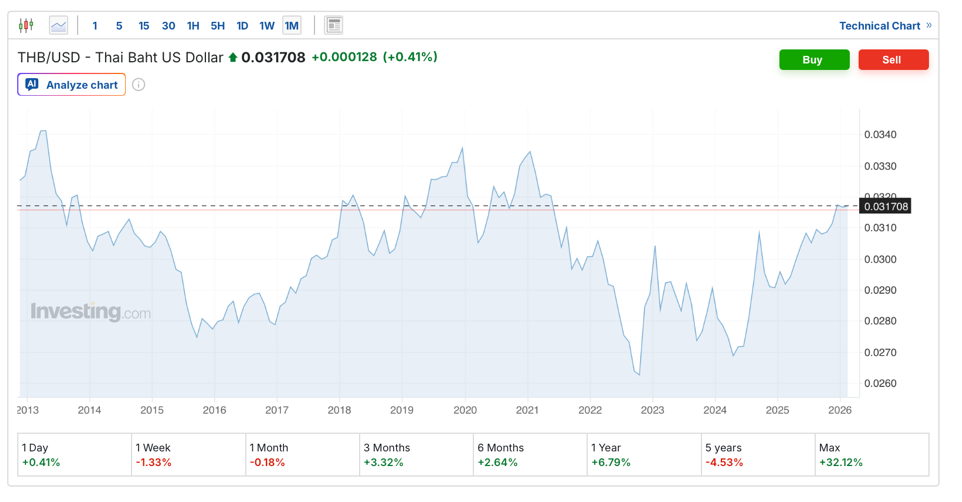
Thai Baht–USD Exchange Rate Trends (2013–2026) Source: https://th.investing.com/currencies/usd-thb
For e-money and e-wallet services, providers are required to connect to Thailand’s Central Fraud Registry (CFR) system, apply transaction limits based on KYC levels, and implement user profiling.
Transaction pattern monitoring will also be strengthened to detect money mule activity, including identifying abnormal transaction patterns that do not align with user profiles, as well as unusually high-value or high-frequency transactions.
“This move of the BOT has had a positive impact on the market sentiment in general, especially in softening the grey money influence on the currency’s appreciation” Wachirawat Banchuen, a financial market strategist at Siam Commercial Bank, talked to The ASEAN Frontier while adding that “this action will solve the problem of gray capital affecting the baht on the spot, but will need to wait for the full USDT-related policy launch in the next few months”
Asked if there are any negative consequences on the overall trading sentiment in the country’s USDT trading, Wachirawat said, “there has been no negative side of implementing the daily cap and monitoring the flow of money yet.”
What Drives the Surge in the Thai Baht?
Despite sluggish economic growth, political uncertainty, and mounting public and household debt, Thailand’s baht strengthened by almost 8% in 2025 and by a further 0.16% in the first month of 2026. The currency’s appreciation has posed challenges for Thailand’s export-driven economy, at a time when disruptions to the global trade system are also weighing on the country’s export sector.
One factor driving the baht’s surge, and weighing on the broader economy, is the inflow of so-called “unrecognised” grey money into Thailand, one of them is the USDT transaction.
How Might Digital Assets Become a Tool for Money Laundering in Thailand?
“In Thailand, there is no single institution that properly regulates the digital asset industry,” said Jitipol Puksamatanan, during an interview with The ASEAN Frontier, Head of Global Investment Strategy at Finansia Syrus Securities.
“Take myself as an example, I often transfer money from my savings account to a crypto exchange, and no one has ever contacted me to ask where that investment money came from,” said Jitipol.
He said this regulatory gap allows grey money to enter Thailand through crypto exchanges.
Asked which institution should take the lead in addressing this loophole, Jitipol said responsibility depends on the nature of the concern. “If you are worried about the impact of USDT transactions on the baht, that falls under the BOT’s responsibility. But if you are concerned about illegal activity or actions that could harm shareholders, that is the role of the Securities and Exchange Commission (SEC).”
The Relationship Between USDT and Gold Trading
Managing Director and Investment Strategist at Merchant Partners Asset, Prakit Siriwattanaket, explained to The ASEAN Frontier that there may be a link between gold trading and USDT transactions in Thailand, which could also be contributing to baht appreciation.
To avoid leaving a transaction trail, individuals seeking to launder money may bring a “cold wallet,” a cryptocurrency wallet that stores private keys entirely offline, into Thailand and use underground agents to illegally convert digital assets into baht.
By doing so, they can move digital assets into Thailand without undergoing KYC verification. They may then use gold trading or USDT as tools to further launder illicit funds.
According to BOT data, online gold trading has had a significant impact on baht appreciation during certain periods. For example, between 20 August and 9 September 2025, the baht gained 2.8%, coinciding with a period when conversions of online gold into baht accounted for 62% of total foreign exchange flows. In another period, when online gold-to-baht conversions reached 24%, the baht strengthened by 4.7%.
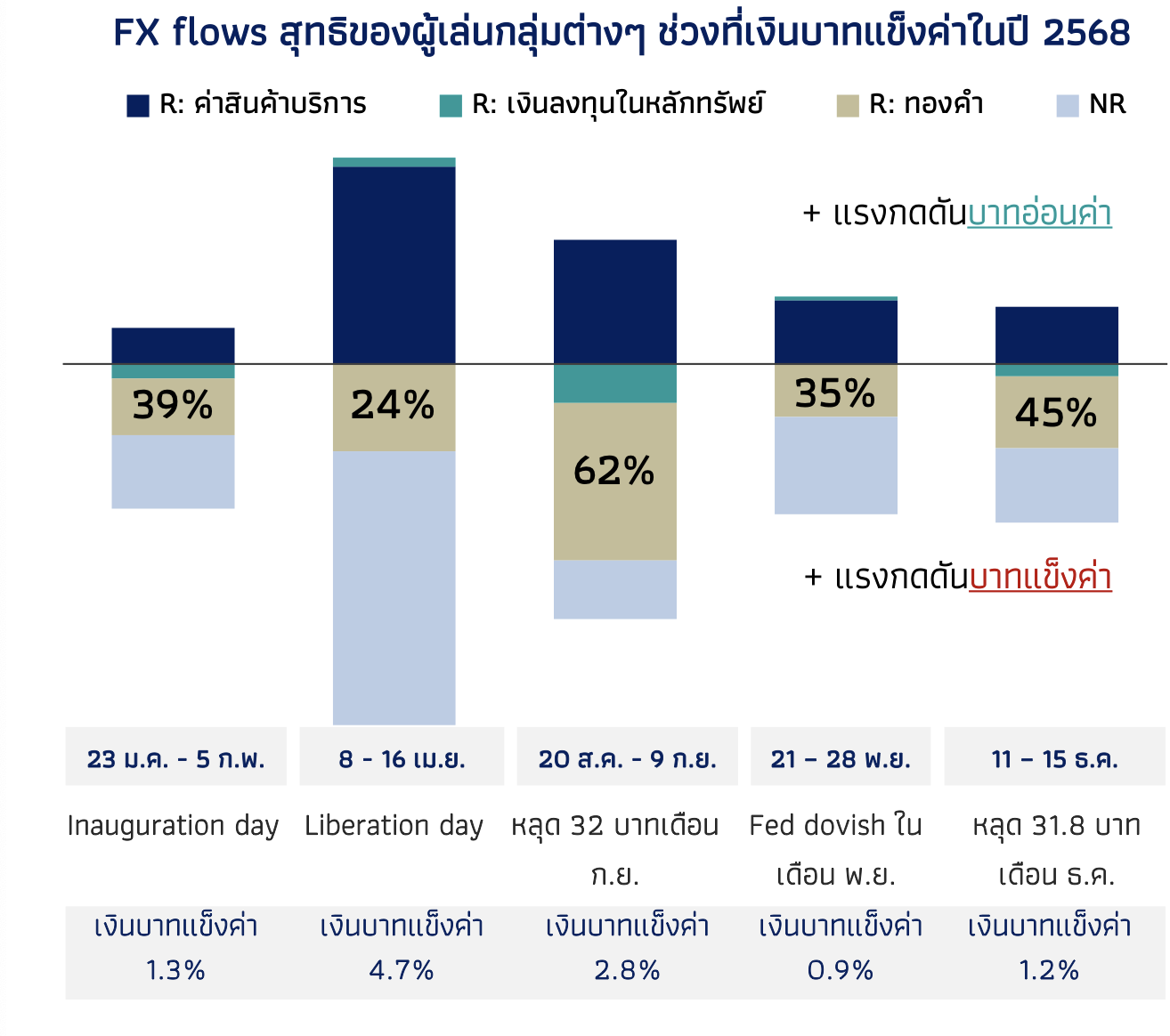
Drivers of Thai Baht Appreciation in 2025 The chart breaks down investment flows (including gold) that contributed to the baht’s rapid strengthening against the U.S. dollar across five key periods in 2025. Source: Bank of Thailand, February 2025
Two Layers of Money Laundering
In an interview with local media outlet The Standard, Sarinee Achavanuntakul, a sustainable finance researcher specialising in sustainable business, said there are at least two layers of money laundering conducted through stock markets or cryptocurrency exchanges.
The first involves moving illicit funds through the purchase of listed stocks. The second is more complex: hiring nominees to secretly gain control of listed commercial banks or cryptocurrency exchanges gradually, with the aim of building a permanent money-laundering infrastructure. Cryptocurrency exchanges are often prioritised due to weaknesses in Thailand’s fraud-related law enforcement.
Edited by Alan, Frontier Analysis Editor