


by Nurul Aini, TAF Correspondent for Singapore
Let me begin with a description of my favourite political meme. It emerged from the winds of Singapore’s General Elections in 2025 and has an undertone that reflects a busy work-driven Singapore, concerned with efficiency. This meme is posted by an Instagram account called “yeolo.sg” that has over 90,000 followers. The name of the account itself plays on the surname “Yeo” and the acronym “YOLO” (You Only Live Once). To add flavour, the “.sg” adds to the humorous nature of the account by making it sound like a legitimate (and very serious) website domain originating in Singapore. The aesthetics of this meme? It reads like a to-do list detailing what residents from the Jalan Kayu Single Member Constituency (SMC) should do “today.” The background is a blurred image of what is assumed to be the location of Jalan Kayu.
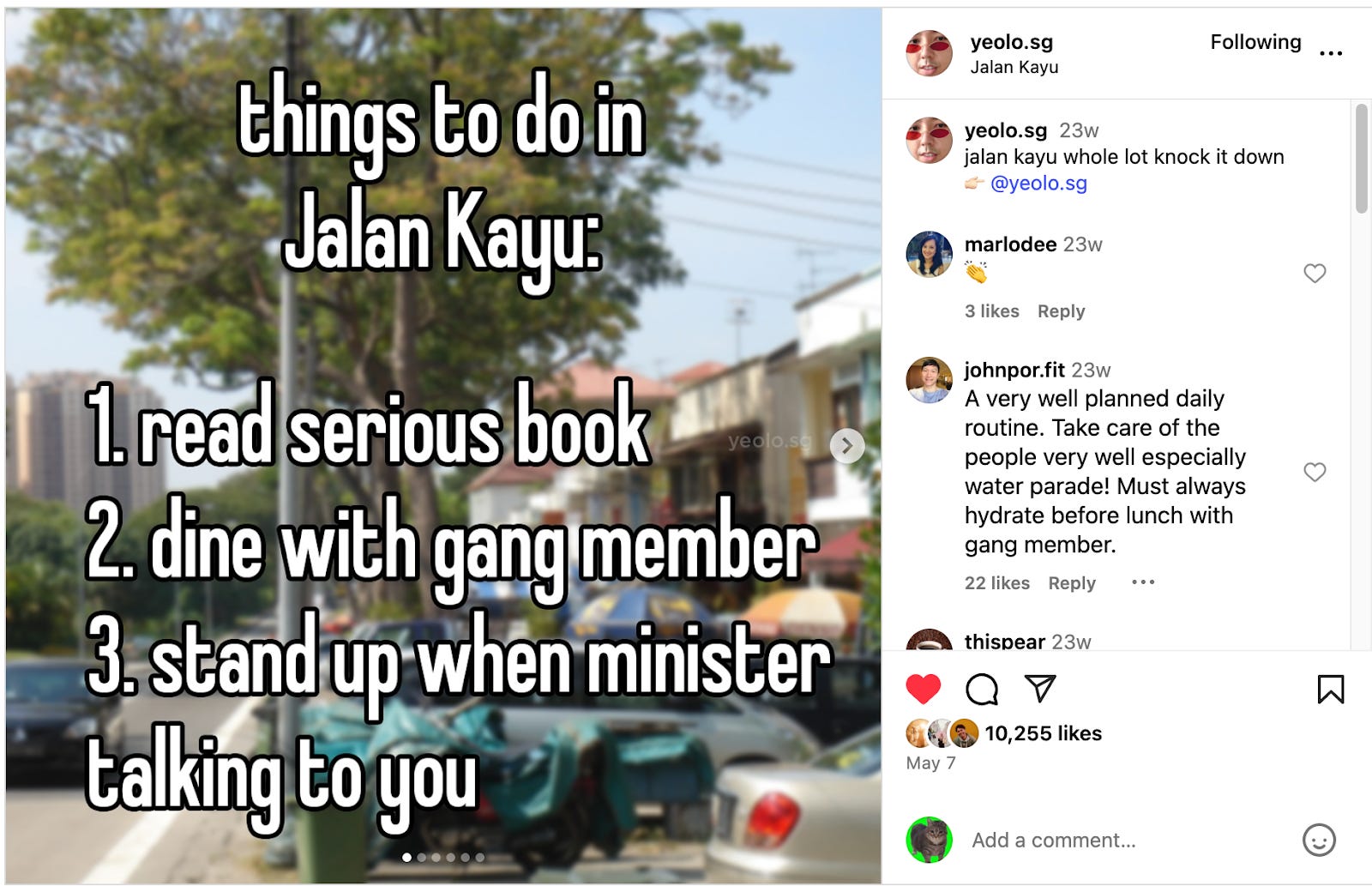
A Jalan Kayu SMC meme in the form of a to-do list posted by @yeolo.sg on 7 May 2025.
This meme emerged from a controversial episode in Singapore’s politics where Ng Chee Meng, the Member of Parliament (MP) for Jalan Kayu SMC and Secretary General of National Trade Union Congress (NTUC) had previously been exposed for supposedly making statements that sounded condescending in a dialogue with educators during a forum in 2017. The meme’s to-do-list references several incidents: the first item mocks Ng’s question to a room of literature teachers about the kinds of books they read, highlighting a binary between “serious” and “fiction”; the second refers to a separate controversy involving several ministers dining with Su Haijin, a Fujian gang member implicated in a money laundering case, who was said to have been present coincidentally; and the third item recalls another moment from the 2017 forum, when Ng instructed a teacher who had finished speaking to remain standing while the Minister was speaking to him. MP Ng explained that he cannot clearly recall the 2017 event but apologized for any lapses in conduct. He also declined to take up any further positions in government beyond his current role as MP. This meme compresses multiple serious political incidents into a satirical to-do list, offering a pointed example of political satire in the Singaporean context.
This rather cynical to-do list lives on as an example (among many) of political participation within the Singapore sphere through the use of humor, specifically political and social satire. This post has over 10,000 likes, a modest amount considering the country’s population, yet it demonstrates notable traction among internet users. While both quantitative and qualitative research would be required to fully understand why and how audiences engage with such content, we might begin by reflecting on our own experiences when encountering this type of satire. For instance, a single act of laughter or chuckle by a user behind the screen potentially reflects two things: (1) the way the meme subverts expectations by framing a cynical critique in the familiar form of a to-do list, and (2) the nature of its target audience, not just the MP, but also voters in Jalan Kayu who are implicitly framed as complicit or agreeable to these satirical commands. To understand the references from the get-go requires familiarity with recent political events particularly during election periods, highlighting the layered nature of political memes. The juxtaposition between the mundane format of a list and the seriousness of each item mirrors the confusion often felt during elections, where politically aware individuals must navigate competing narratives and decide where their loyalties lie.
Could memes of this nature serve as a way to increase political participation among Singaporeans, especially given the presence of laws like the Protection from Online Falsehoods and Manipulation Act (POFMA) and the tendency toward self-censorship in society? POFMA itself has been subjected to citizen pushback, debated publicly and flagged by Civicus Monitor as a law that restricts freedom of expression. The looming sense of fear through the existence of such laws could translate to citizens’ self-censorship. Yet Minister of Law K. Shanmugam insists that there is nothing in Singapore’s law that prevents citizens’ autonomy to express themselves, so long as they avoid attacking the race and religion of others. The overview above serves to demonstrate the sometimes conflicted perspectives in Singapore’s society on certain aspects of laws within the country, especially if it concerns citizens’ political expression. There are indeed intricacies to be navigated when it comes to Singapore’s laws on media reporting and political expression which are not within this article’s scope.
Instead, this article presents additional political memes to demonstrate how Singaporeans are actively overcoming their self-censorship. Here, I argue that complementary to conventional political engagement – such as petitioning, (restricted) protests, and dialogues with politicians – political memes function as a micro-form of participatory politics. Through digital and cultural means, citizens critique politicians’ behaviours, ideas, or actions. As such, memes can serve as a critical tool for fostering political participation and shaping public opinion. Moreover, memes with political and social satire also cultivate a sense of Singaporean identity through the use of colloquial language, such as Singlish (Singaporean English), thereby forming an online subculture.
This article analyzes three memes, taken mainly from local meme Instagram pages, to explore how digital satire fosters political and social participation among younger Singaporeans. Each meme incorporates niche local references and targets a digitally fluent audience familiar with online culture. The first meme presents a “Trade Offer” meme that reflects a candidate’s attempt at appealing to young voters who are struggling with job search. The second meme plays on the phrase “can is can,” a local expression of possibility, to suggest deeper intellectual commentary. The third meme shows a well-known politician portrayed as a tired local man, using humor to challenge authority and connect with a broader audience while questioning what it means to be Singaporean. The different variations of these memes then demonstrate efforts within the Singaporean social media sphere to increase political and social participation.
Memes can take on various formats such as texts, images and videos. Political memes, in particular, are a subset of a vast repository of memes that address issues related to politicians, power dynamics, and the concerns of the ordinary citizens. Within the context of the United States, political memes, as argued by Audrey Halversen and Brian E. Weeks have been used to “comment on the mistakes and hypocrisies of politicians” (2) and to spread “messages and calls to actions related to social movements, such as Occupy Wall Street and Black Lives Matter” (2). This has a democratizing effect where citizens are engaged with ongoing political unfoldings, and political movements while on-the-go. Social media features like saving, sharing, reposting, and publishing amplify the reach of these memes, allowing political critique and expressions of support to circulate widely in everyday life. Memes also serve additional functions. Its fusion of laughter and politically-oriented anger is ‘cathartic’ for its audience, and provides a space in which initial feelings of disagreement or bleak political realities are made more ‘palatable’ while validating emotional or intellectual dissent. Memes also allow users to “believe they are less vulnerable to criticism when they express a political opinion through an entertaining meme” (247), which signals that the content is not meant to be taken personally (247). With memes, audiences who wish to be more politically engaged are more likely to participate behind the veil of social media anonymity.
Within this anonymity lie further intricacies: memes have evolved into a distinct mode of communication, generating and spreading a unique language that blends structural and linguistic elements of humor. As meme content fluctuates between overt messages and cryptic references, their enigmatic nature can foster political discourse in a manner that feels safe and accessible, especially given their digital medium. At the same time, memes can be weaponized as an overly-simplified tool that reduces socially-important issues into laughable images with little real-world impact.
Ultimately, the difference between meaningful discourse and trivialization rests in the hands of internet users. As Nicholas Fang, Director of Security and Global Affairs at the Singapore Institute of International Affairs, notes, users have the power to decide whether such memes spark genuine conversations. Dr. Natalie Pang, a senior lecturer in Communications and New Media at the National University of Singapore’s Institute of Policy Studies, further observes that laughter can signal acceptance of the meme and its underlying message, suggesting a “conversational” exchange between the individual and the meme encountered.
Eventually, memes can serve as a lighthearted start to more serious conversations and should not become “thought stoppers” that hinder comprehensive and extensive social commentary on issues that affect people’s lives. Furthermore, The Straits Times, a news outlet in Singapore, has compiled a list of memes that have emerged during General Elections over the years, highlighting the significant impact of political memes on how the public remembers political candidates and key moments in Singapore’s political history. In a city-state where political apathy is arguably much more prominent, this also means that humor opens up space not only for engagement but also contentions in political discourse that prompts audiences to engage through posting and commenting on such memes.
Since memes have their own set of language, there are ways of reading and interpreting them. From being only funny images circulated for public online entertainment, memes can then be reconceptualised as a critical tool for dissent when appropriately read. Wee Yang Soh presents an epistemology in reading memes and argues that there are three “intersecting pieces of knowledge” (1122) needed in interpreting memes. He argues that “first, a recognition of the ‘meme-ness’ of the image (i.e. its mimetic chain); second, a comprehension of the image’s aesthetics; and finally, a familiarity of the ‘local’ event that the content of the meme is implicitly referencing” (1122). Here, Soh suggests that a meme works well when users recognise the origins of the meme by identifying any distortions from the original catalyst. Although the source material may not be humorous, structural modifications – especially when political content is woven into the meme’s design – create its comedic effect. This sometimes can come in the form of appropriation and juxtaposition. For instance, using the structure of news reports to ‘report’ on unserious matters. Additionally, Soh also insists that users understand how the various aspects of the meme – although seemingly ‘casual’ or fragmented in its aesthetics – are pieced together into a cohesive laughable object. Most importantly, Soh contends that users must already be familiar with the news or events being referenced to fully grasp a meme’s meaning, especially when comprehension is the goal.
Much like reading a literary text with a pen in hand, standing before an artwork in a museum while intently searching for meaning, or watching movies with eye for symbolism, the interpretation of memes requires attentiveness to detail and a willingness to pause – uncovering the seriousness beneath the seemingly unserious. That is, to read between the lines that such humor conceals. Furthermore, much like the practice of intertextuality in literary interpretation, it is crucial for interpreters of memes to recognize the “mimetic chain of the meme itself” (1122) where its recognition as a meme requires the “consumer to make an interdiscursive leap to read each chain against the other. The latter is recruited as an evaluative typification of the former, and thus they mutually co-textualize each other” (1124). In other words, as the meme evolves from one structure to another, the recognition of this change alongside the content engineered into it, drives its politicization.
As such, the ambiguity in such memes allows meme creators and users in general to participate in “digital activism,” or “digital resistance”: not resistance to digitalisation itself, but rather the use of digital platforms to express political dissent or, ironically, to educate the public through unconventional means. Though merely virtual and deemed as insignificant in light of more ‘grounded’ forms of protests, memes ground themselves as “political artifacts” (1119). That in its inherent politicalness, it initiates the user into the meme’s humor through laughter. The labour of ‘excavating’ these memes thus reconceptualizes laughter as a political act and a cynical form of protest that leaves the imagined subject of laughter momentarily stunned and confused.
Particularly for political memes, they can act as a form of “semi-journalism” that provide ongoing political commentary while allowing users to make sense of various political unfoldings (239). Take, for example, this meme taking a jab at an opposition candidate:
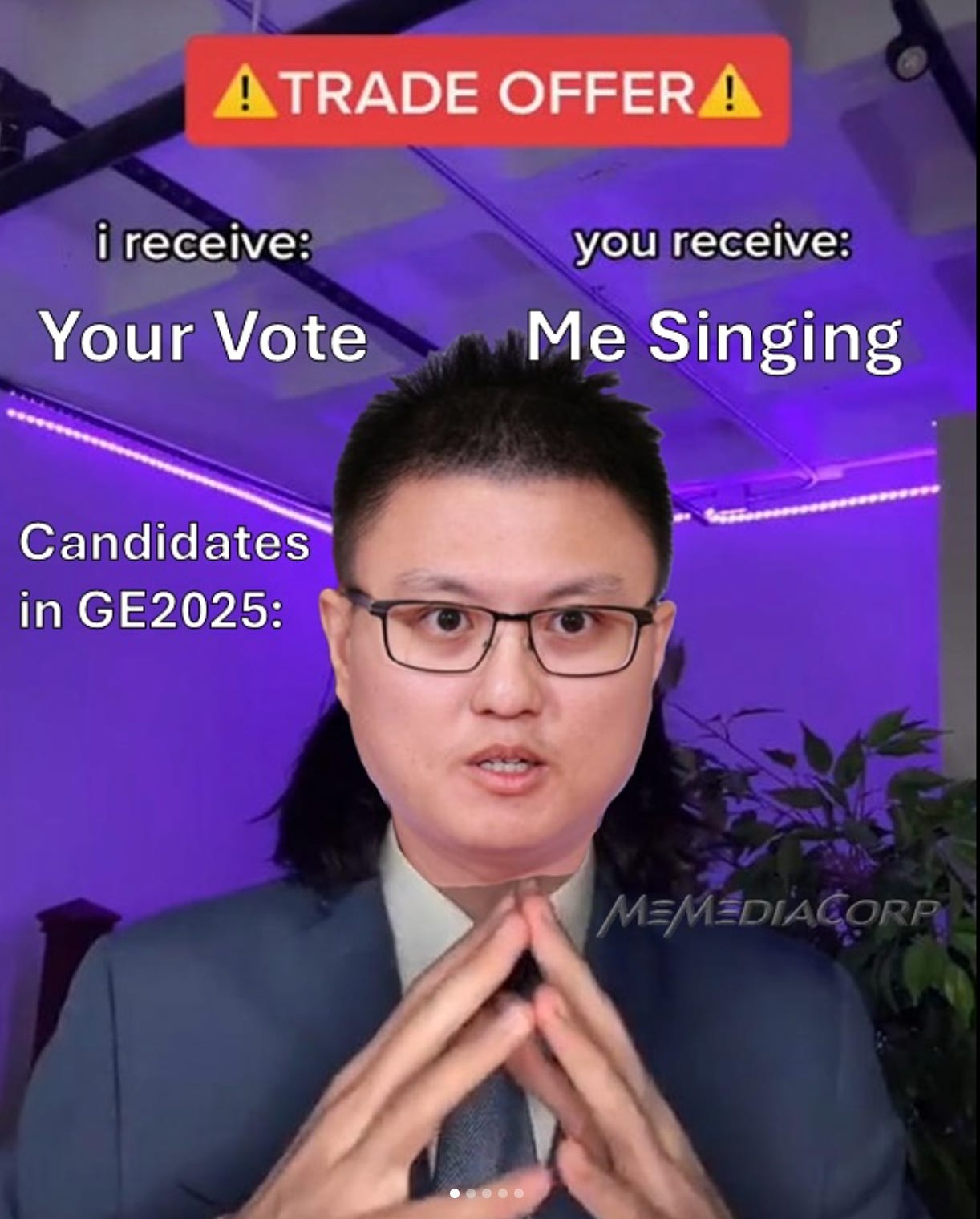
Meme with Samuel Lee (previously from the People’s Power Party)’s face transposed on a different body posted by @memediacorp on 3 May 2025. Lee had joined the party in late 2023 and went viral for singing during a media interview when running for elections in 2025.
This image transposes the head of the candidate onto a male body draped in suit, with hands gestured in all the seriousness of an important deal while the phrase “Trade Offer” looms above the body. This signifies that users must now pay attention. The deal, however, is a trade offer that exchanges the candidate’s singing in return for a vote. The choice of the candidate is not without its significance. Samuel Lee who had previously been from the PPP had adapted the tune of a Chinese song called “I’m Just a Tiny Bird” from its original language and had sung it live during a media interview. This was an attempt to echo the sentiments of youths who are struggling with job search. While the video itself was widely circulated and became a meme reappropriated over and over again, the act of creating what Soh has previously mentioned as a “mimetic chain” through another pictorial meme only proves the point of a mise-en-abyme effect of memes that travels at a rapid pace as meme creators (and non-meme creators) capitalizes and appropriates these memes into engaging and relatable references. While the meme doesn’t offer factual election updates, it can spark curiosity about how candidates try to appear more relatable, serving both as a political icebreaker and a subtle critique of their campaign strategies.
Beyond the general elections, memes in Singapore also act as a continuous act of participatory democracy, hinging upon the use of diverse permutations of the English language. This following meme is a rather niche meme that uses Singlish (Singaporean English):


Meme in the form of Instagram story format (left) and its caption (right) posted by @yeolo.sg on 16 September 2025. The caption fuses a sentence from the widely circulated passionate speech by the National Solidarity Party (NSP)’s Choon Hong Heng in 2015 during his rally, with the Singaporean slang “can is can.”
The phrase “can is can” is a vocabulary in Singlish that denotes the possibility of doing something. Say, for example, you propose an idea for a group project, your teammate would respond with either “can is can!” to affirm their agreement of your idea or “can is can but…” before jumping in with disagreement on any aspects of the matter. In this meme, to “clock in another shift” in the “can is can factory,” satirizes the use of this phrase. It suggests that certain possibilities remain merely possibilities but it can also mean that Singaporeans have no choice but to have an incredibly positive mindset to push through another work day. Additionally, conceptualizing Singapore as a “factory” exacerbates the notion of a work-oriented nation. The use of Singlish in memes, in my opinion, amplifies the uniqueness of critique within the Singaporean sphere. As a mode of communication that was built from the ground-up among the community in the early 1970s as a linguistic phenomenon that traverses language barriers, Singlish had been the target of the “Speak Good English Movement” (SGEM) by the Singapore government in April 2000. In contemporary times, as argued by Dr Daniel Chan, a senior Lecturer at the Centre for Language Studies from National University of Singapore, Singlish is identified as an essential element of Singapore’s national identity (despite claims of it as “broken English”) and the switching between Singlish and standard English can be categorised as a mode of translanguaging that demonstrates how global communication and local identity can coexist. In relation to fostering social identity, one of the reasons users engage with memes is the sense of relatedness through “shared beliefs, experiences, norms, and cultural elements” (242). Evidently, the “content or semantic of memes can create this feeling of relatedness” (242). Hence, Singlish as a mode of fostering national identity structured into a meme reaffirms that this deceptively simple meme indeed promotes a sense of belonging through the use of slang while being a means of social commentary that poses solidarity with fellow Singaporeans.
Apart from edited images, niche language references and academic re-imagination, Singaporean political memes also resort to overly simplistic language in a bid to deliver their message. Consider this meme, for example, where both posts are posted consecutively, stretching the boundary of its ‘meme-ness’ across two posts.

A series of memes with former Prime Minister Lee Hsien Loong described as a local man posted by @thepressingtimes.sg on Instagram on 15 April 2024 (right) and 16 April 2024 (left). During this time, Lee had announced that he was stepping down as Prime Minister of Singapore.
This meme is particularly striking in its characterization of Lee as a “local man” who is “done” with his job as Prime Minister, conveying a nonchalant tone. The picture on the right, nonetheless, showcases him with a big smile. Coupling this with the headline echoes a sentiment of the common citizen who is elated to resign from his job. Yet, the juxtaposition of the picture on the left is what brings out its humor. The headline supposedly refers to the clarification done by Lee that despite stepping down as Prime Minister, he will continue serving as a Member of Parliament. Thus, he becomes a local man returning to work. While Lee’s real life statement echoes that of positive commitment, the meme humorously portrays him as a reluctant employee, reinforcing a broader commentary on the exhausting nature of work. While not necessarily reflecting Lee’s own sentiments, the meme serves to reflect the idea of the local individual tied to working which, in this case, is presented as an exhausting process.

Accompanying caption to post posted on 15 April 2024 by @thepressingtimes.sg
Moreover, the caption to this meme flattens the pomposity often associated with transitions of power, portraying the handover as simply a Chinese Singaporean man who is “done” with his work. By juxtaposing Lee’s position as an important politician with plain, non-descriptive language, the meme resists dramatic news headlines and instead portrays this event as yet another occurrence to move past. The oft-repeated usage of “done” without any further elaborations on the exact scope of being “done” suggests a rather blasè tone, exacerbating the idea of an exhausted local working man who only wishes to leave his job. By pointing out that the statement of “I am done” is made “gleefully or fearfully,” the meme also highlights the uncertainty that comes with quitting a job, mirroring public anxieties about employment more than Lee’s uncertainty.
While the meme updates viewers on Lee’s resignation as Prime Minister, it also powerfully reflects the broader exhaustion around job-related decision making. As a page for political satire, The Pressing Times claims non-partisanship and seeks to add nuance to political discourse through ironic humor. Despite having to navigate a landscape where satire could be misinterpreted as spreading fake news, its creators emphasize the goal of encouraging media literacy by prompting viewers to fact-check. Like the Samuel Lee meme and the “can is can” meme, this post updates audiences on political changes while using simple, relatable language to reflect or construct Singaporean social identity.
All in all, the continual creation of such memes is a relatively ‘safer’ and candid way to bypass the culture of self-censorship. In its content, it serves to echo citizens’ sentiment and sometimes amplifies concerns overlooked by the general public. In its presentation of differing opinions, memes can function to boost or influence collective consciousness surrounding political events and figures. In their form, through the utilization of niche local languages, memes can promote national unity by validating the unspoken negative emotions associated with societal norms (i.e. being expected to always be 100% efficient in the workplace). Thus, memes remain vital to political and social engagement within the digital sphere: a means of political persuasion whose art must be preserved and whose power should remain in the hands of ordinary people.
Edited by Tony, Editor at TAF
