


by Christopher Lim, External Contributor
For decades, Malaysia’s nation-building project has been inward-facing; focussing on managing racial complexity, ensuring stability, and building the foundations of a modern economy. This approach has delivered real progress. But as the global system fractures and reverberations are felt around the Indo-Pacific, it is no longer sufficient. This article argues that Malaysia’s next chapter requires a shift in perspective: from inward management to outward purpose. What the country lacks is not capability, but a unifying idea that defines our role in the world. Existing ambitions such as becoming high-income, moving up the value chain, maintaining non-alignment are important, but they describe outcomes and methods, not purpose and identity.
Malaysia’s geography and history point to a clearer answer. Situated along the Straits of Malacca, one of the world’s most critical trade corridors, and shaped by centuries of historical heritage of movement, Malaysia is not merely a participant in global commerce, but is positioned to become a central node within it.
To realize this, Malaysia must dedicate itself to becoming a modern trading civilization: A country where nations come to trade goods, invest capital, and exchange ideas. Where its people are open, and they explore the world.
Malaysia should build a nation of, and a nation for, explorers.
Where it started
Whether consciously or not, many Malaysians are familiar with this question: What is Malaysia? What defines the country and its people as Malaysians? Are Malaysians characterised by their multicultural, multiracial, and multireligious diversity? Or simpler still - it’s the child-like wonder of, “Who are we?” The common answer may sound familiar: Malaysia is defined by her people.
They carry a rich tapestry of history: from unwilling neighbours ferried to support British colonial trade, to post-independence citizens tied together by Satu Malaysia. A melting pot of food, language, and that unmistakable Malaysian twang. Malaysians are less defined by similarity, and more by their differences.
Yet, sometimes, in the space where a national identity should sit, many have wondered if the harmony is held together less by a coherent idea of unity, and more by a quiet fear of disharmony.
Malaysia celebrates Satu Malaysia, but how many have more multicultural friendships than their parents did? And how do those compare to their parents?
The country continues to be moulded by differences inherited from an older time, and still allows the future to be shaped by the same paradigm. Surely, this must change. A new way of thinking about Malaysia’s future is required, and this article presents a thesis for a way forward.
It’s time to look outwards, not inwards.
The majority of Malaysia’s nation-building literature largely explored the question of Malaysia’s future by looking inwards.
Most start by tracing the curvature of colonialism beneath the smiles of ordinary Malaysians, and find that British racial separation birthed a constitution that embeds our differences as an institutional reality.
Unlike its Southeast Asian neighbours, who chose to suppress racial differences in pursuit of a unified identity, Malaysia chose to embrace them. From there, there was no turning back.
Malaysia was forced, from the onset of its genesis, to start nation-building by looking inwards. Institutions and policies were designed to distribute wealth along racial lines, managing a delicate balance that demanded constant attention. For the consequences of failure snake beneath every Malaysian’s subconscious: Malaysia cannot afford another May 13.
In effect, much of what Malaysia built as a nation was shaped by race. It became a country that understood itself through its internal racial dynamics, rather than its external place in the world.
For the last 70 years, this was not only understandable, but necessary. How can a country look outward if it is not yet stable within?
In the 1970s, Malays controlled only a small share of corporate equity despite forming the majority of the population. Rural states such as Kedah, Kelantan, and Pahang lagged far behind more urbanised regions like Selangor, Johor, and Penang. In East Malaysia, social mobility was limited, and for many, economic advancement remained a distant aspiration.
Since then, Malaysia has made real progress. Poverty has fallen dramatically. Inequality has narrowed. Participation in the modern economy has broadened. The economy has expanded, and human development indicators have improved significantly states data from Sultan Nazrin Shah’s book Striving for Inclusive Development, which traces Malaysia’s economic journey from its colonial roots to the present day.
But progress did not come without cost.
Institutional weaknesses enabled periods of corruption and misgovernance. Race-based policies, while addressing inequality, also created distortions that continue to shape the economy today.
Yet, through these imperfections, something else emerged.
From the cracks of its early struggles grew institutions and infrastructure that defined the Malaysia Boleh (Malaysia can do it) spirit. Malaysia now has strong physical infrastructure, a capable financial system, widespread connectivity, and a population that is increasingly educated and globally aware.
In many ways, Malaysia is ready.
And this is increasingly recognized, not just by observers, but by policymakers themselves. In recent years, there has been a wave of national strategies: the 13th Malaysia Plan, NIMP (industrial), NETR (energy), and the Defence White Paper. Together, they signal a renewed push to re-energize growth and reposition the country.
Perhaps for the first time since Mahathir Mohamad (Malaysian Prime Minister) sparked a frenzy for industrialization that catapulted Malaysia into a middle power, there is a recognition that the country stands at the precipice of something great.
As Liew Chin Tong argues in Second Takeoff, this is Malaysia’s time. As global supply chains shift and geopolitical tensions reshape the world economy, a new wave of industrialization is underway. Countries that position themselves well will capture the next phase of growth.
For 70 years, the country looked inward. Now, it must begin to look outward.
This is not to deny that challenges remain. Malaysia’s internal issues have not disappeared. But the path forward may not lie in continuing to look inward alone. It is through the outward journey of pursuing a Grand Strategy that the country will reshape how it sees itself.
Its diversity, long treated as a source of tension, will begin to find new meaning. Its pockets of economic aspirations will orient themselves to serve a wider purpose.
Like sailors on land who spent decades fixing their vessels, Malaysia’s entire nation-building apparatus will finally set sail towards this true north. And in doing so, the country may finally arrive at an answer to the question it began with: What is Malaysia?
Crafting Malaysia’s Grand Strategy
A grand strategy is the overarching, long-term plan that defines a nation’s core objective and aligns all its resources: economic, political, military, and social, to achieve it amid a contested global order.
At its core, it must answer three questions:
What is Malaysia trying to become? (state/identity)
Where does it play? (geography, domains, arenas of competition)
How does it align everything to get there? (policies, institutions, capabilities)
If these three do not connect, what exists is not a grand strategy, but a collection of initiatives.
The ambition of this article is simple, but demanding. It is not to examine Malaysia through a single lens, but to define what Malaysia should be by holding its geography, history, economy, institutions, and identity together as one system.
Yet even with years spent studying Malaysia’s development, answering a basic question remains difficult: what is Malaysia’s grand strategy?
The answers available today are, at best, incomplete. Consider the familiar description:
“Malaysia is a strategically positioned, multiethnic middle-income nation balancing export-driven economic ambition, state-guided development, and social cohesion while navigating identity, governance, and geopolitical complexity.”
This may sound accurate, but it is not distinctive. Replace “Malaysia” with Indonesia, the Philippines, India, Turkey, or Brazil, and it would still ring true.
At best, Malaysia’s current policy direction suggests that it aims to become a stable, inclusive, high-value economy and a neutral middle power embedded in global supply chains. But this is not a grand strategy. It is a well-coordinated development approach.
It tells how Malaysia grows, but not what it aspires to grow into.
Consider this:
“High-income nation” is an outcome, not an identity.
“Move up the value chain” is a method, not a direction.
“Neutral middle power” is a posture, not a purpose.
Malaysia knows how it wants to grow, but not what it wants to grow into.
It is, in many ways, like a chef with all the right ingredients, but no dish defined. Or a ship in choppy waters, with capable sailors and a sturdy vessel, but no clear destination.
This gap becomes clear when examining national policies.
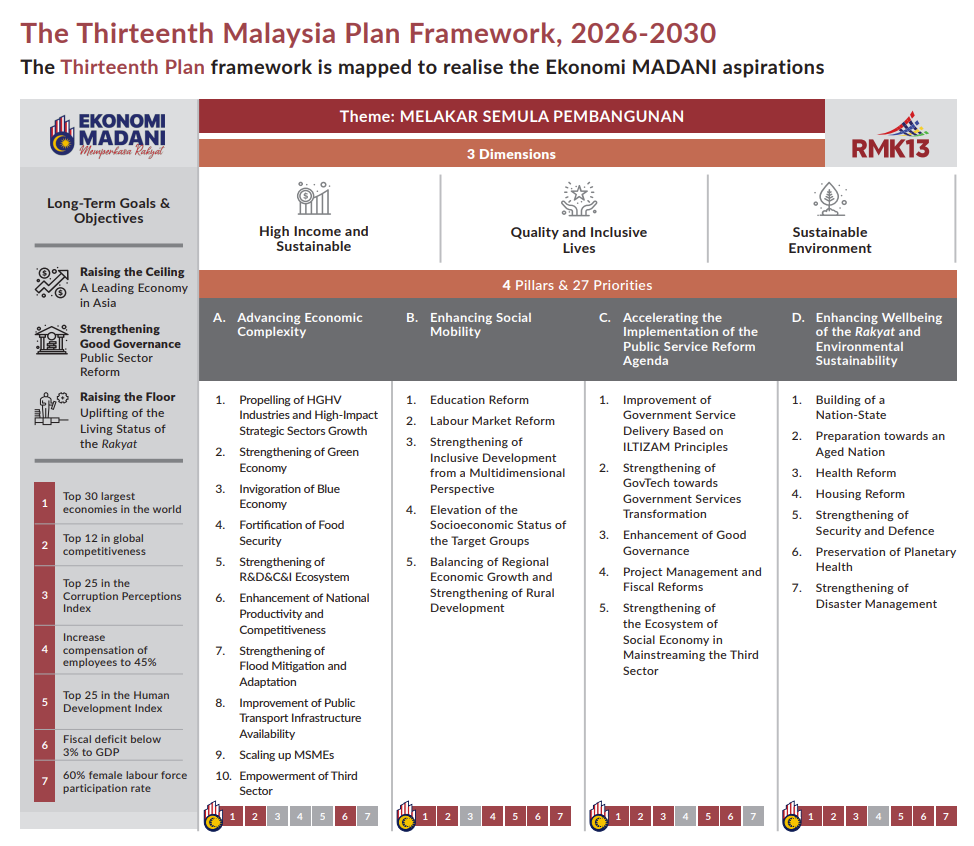
The 13th Malaysia Plan, for example, outlines a broad set of domestic priorities, with limited articulation of Malaysia’s role on the global stage.
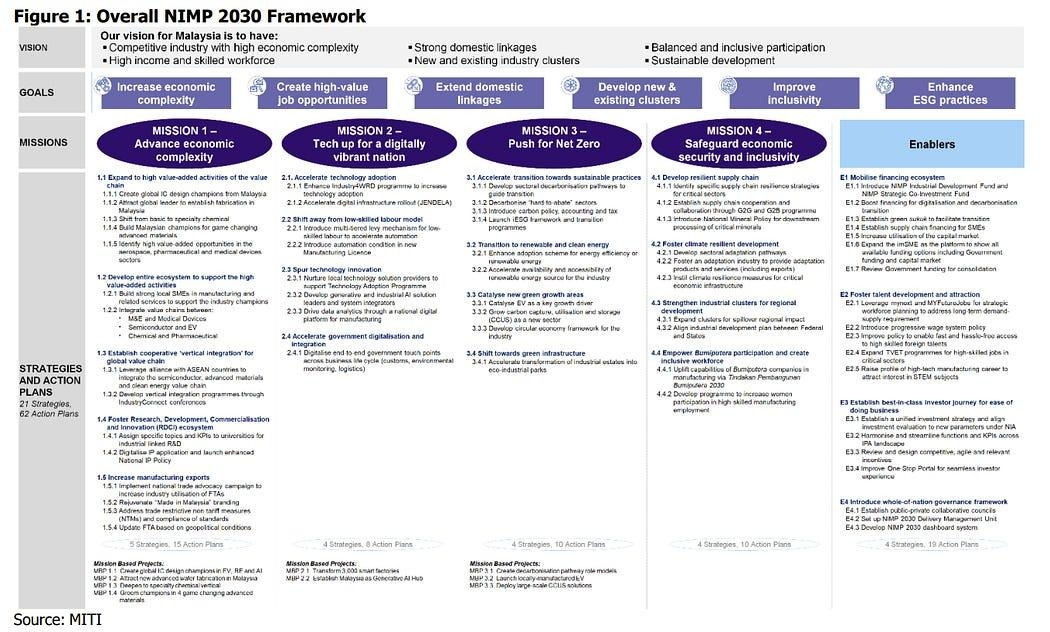
Similarly, Malaysia’s industrial policy (NIMP) identifies the right capabilities such as advanced manufacturing, digitalization, net-zero, and supply chain resilience, but offers little clarity on the unifying purpose behind them.
Why is Malaysia digitalizing? Why is it pursuing net-zero? Why is it revitalizing manufacturing? Beyond responding to global trends, what is the larger role Malaysia is trying to play?
An articulation of a Malaysian grand strategy can be found in the aforementioned book by Liew Chin Tong (The Second Takeoff). In this interpretation, he makes a memorable argument that Malaysia’s direction is to achieve three Ms:
Middle-Class: To grow rich before growing old.
Middle-Power: To be a non-aligned middle power that serves as a conduit between the West and East.
Middle-Ground: To occupy the “middle” in manufacturing (e.g. assembly), leveraging its “middle” position between East and West.
But even this framing does not provide a clear direction for Malaysia.
Having a strong middle class signals a stable economy, and being a non-aligned middle power is an approach. Occupying the middle ground in manufacturing is an industrial strategy. These are important but they do not, in part or in full, define what Malaysia is meant to be.
What emerges, then, is a pattern. For decades, Malaysia’s socioeconomic development has largely been inward-facing, focused on stabilizing the racial-religious balance while pursuing industrial growth. This model has served the country well. But it cannot be the path of a country on the precipice of its next chapter.
This is the moment to ask a different question - not just how Malaysia grows, but what it will grow into.
Any meaningful answer must be clear, practical, and carry a call to action; one that defines what Malaysia must become, and, when examined closely, reveals the foundational core of what makes a Malaysian.
Malaysia as a Trading Civilization
Some countries must struggle to create relevance in the world. Others have relevance thrust upon them by sheer size or by geography that places them at the center of global affairs.
China and India derive relevance from scale. As vast continental powers, their populations provide depth and internal momentum. The same is true of the United States which is shielded by the Pacific and Atlantic, bordered by relatively stable neighbours, and able to grow into a global center of innovation and capitalism.
Others derive relevance from movement. The Gulf states, such as the UAE, have leveraged their position along critical trade and energy routes to become hubs of commerce and connectivity. Similarly, small states like Singapore have capitalized on geography to attract capital and talent. In these cases, relevance is not driven by size, but by proximity to global flows of goods, capital, and people.
Malaysia belongs to this second category.
It does not possess the scale of continental powers, nor the singular continuity of older civilizations. But it sits along one of the most consequential waterways in the history of global commerce - the corridor linking the Indian Ocean and the Pacific.
Malaysia has the Straits of Malacca.
Long before the modern nation-state, the Malay world thrived as a network of maritime trading communities. The Malacca Sultanate became a crossroads of cultures and economies, a resting place where merchants, scholars, and diplomats gathered to exchange goods and ideas.
Trade did not just bring wealth. It shaped a shared identity. The people of the Malay world became defined by movement, exchange, and exploration.
As such, the diversity that defines Malaysia today did not arise in isolation. It is the birthmark of a land shaped by centuries of trade, migration, and exchange. Malaysia’s diversity is not merely a byproduct of colonial history, but the inheritance of a trading civilization that once stood at the center of its world.
Today, the global system is reorganizing once again. The Indo-Pacific has become the central arena of economic dynamism and geopolitical competition. Supply chains are shifting. Trade routes between East Asia, South Asia, the Middle East, and Europe are deepening.
The system before Malaysia is being rebuilt. And parts of it are being rebuilt around it.
The Strait of Malacca remains one of the most vital trade corridors in the world. But geography alone does not guarantee influence. Malaysia’s strategic advantage must be cultivated through institutions, infrastructure, diplomacy, and capability.
Singapore understood this early. It did not merely benefit from its location but organized its entire system around it. By leveraging its maritime position decades ago to become the epicenter of regional trade, it used that advantage to become the financial, military, and intellectual drumbeat of the region.
Does Malaysia not stand at such a moment too?
There are strong instincts in adopting the right developmental policies. Manufacturing growth, export-led industrialization, and integration into global supply chains have transformed the country into a middle-income economy. Its ports are active. Its industries are competitive. Its society is diverse and capable.
Malaysia knows how to grow. But not what it is growing into.
The answer lies in something both old and new: Malaysia must turn its core into a trading nation once again. Not only of goods, but of capital, ideas, and exchange.
And this begins at sea.
Maritime trade is Malaysia’s natural foundation. The country already possesses ports across Penang, Selangor, Johor, and the East Coast. Capturing trade flows begins as a (behemoth) logistical challenge to attract transhipments away from Singapore. But if achieved, the long-run benefit is clear: global flows become anchored to Malaysia.
From there, everything begins to align.
Manufacturing gains purpose when it is positioned close to trade. Supply chains deepen when firms see Malaysia not just as a production base, but as a gateway. The export-led model becomes more powerful when it is tied directly to both Eastern and Western markets.
Maritime trade connects global demand with the supply from Malaysia’s re-industrialization objectives.
Growth then spreads. Industrialization strengthens existing hubs of Penang, Selangor, and Johor, and gradually extends outward as demand increases. States that were once peripheral gain new relevance as part of a larger system of production and exchange.
Even Malaysia’s military and foreign policy begin to align. A stronger role in trade demands a more capable naval and aerial presence to secure its waters. Its non-aligned foreign policy becomes an advantage as a platform of neutrality and trust in an increasingly divided world. Malaysia moves from participating in ASEAN to shaping it through connectivity and integration.
Tourism evolves alongside this as traders, investors, and talent flow through Malaysia. Its diversity becomes an asset on display, not a tension to manage.
And perhaps most importantly, in what started this entire essay, Malaysia inherits a renewed sense of identity.
A country that has long looked inward begins to look outward. Diversity is no longer just something to manage, but something to present. Malaysia becomes defined not just by its differences internally, but by how it showcases its diversity externally.
And if the above sounds far-fetched, the argument here is to the contrary.
This vision does not replace existing ambitions, but gives them meaning. Industrial policy, digital infrastructure, green energy, and innovation all remain essential. But within a trading strategy, they are no longer isolated efforts. They become parts of a coherent Grand Strategy.
Malaysia already possesses the foundations. Its geography places it at the center of key trade routes. Its ports, industries, and workforce are deeply connected to global markets. Its diplomatic posture remains balanced and pragmatic.
What is lacking is not capability, but clarity.
If developed intentionally, Malaysia can become a central, trusted platform for trade, production, and exchange in the Indo-Pacific.
This will not be easy. Institutional fragmentation, governance challenges, and gaps in execution remain real constraints. But they are not new, and they are not insurmountable.
Malaysia’s forefathers have done this before, and it can do so again.
The civilizations that once thrived along these shores succeeded not because they had more resources, but because they understood that success meant organizing themselves around global movements that are bigger than themselves: movements of goods, people, and ideas.
Today, Malaysia faces a similar moment.
Reclaiming History and Aligning Future
The question is not whether Malaysia can participate in the global system. It already does. The question is whether it will define its role within it, or continue without one.
Reclaiming its historical heritage as a trading nation offers that definition. It connects its geography to its future, aligns its capabilities with purpose, and places Malaysia not at the margins of the Indo-Pacific, but at one of its natural centers of gravity.
This should be Malaysia’s Grand Strategy.
This is what Malaysia must grow into.
Edited by Nishiha Jasper David, Frontier Analysis Editor

maybe it’s not that we don’t know how to grow
we just don’t translate that growth properly to everyday life
and also… we start things well
but consistency and execution always lari halfway
so end up people lose trust
we have potential
just belum pandai sustain it and make it feel fair to everyone